
Get Involved

The Arizona Mortgage Lenders Association was developed for its members, by its members and we need your help! … [Click Here To Learn More...]

Capital Commentary
By Kirk Willison ● May 20, 2026
Type “CRT” into a search bar and you’ll see a lineup of old TVs, a culture debate, a pacemaker setting, and, somewhere down the list, our topic today: Credit Risk Transfer.
Why it matters: It’s the quietest CRT out there, but it’s supported by a hefty balance sheet.
The big picture: CRT, once a niche function within Fannie Mae and Freddie Mac (the GSEs), is now grabbing attention in Washington. Lawmakers from both sides are urging FHFA Director Bill Pulte to broaden its use.
The stakes: With policymakers considering the release of Fannie Mae and Freddie Mac from conservatorship, deciding who takes on mortgage credit losses is more crucial than ever. CRT has quietly been the go-to solution for over a decade.
1 big thing: The ABCs of CRT

Before 2013, the GSEs held nearly all the mortgage credit risk in the conventional U.S. housing finance system on their own balance sheets, almost $5 trillion worth at the time of the 2008 crisis.
- When borrowers defaulted en masse, taxpayers picked up the tab to the tune of $187.5 billion in capital injections.
The fix: Credit risk transfer. Starting in 2013, under then-FHFA Acting Director Ed DeMarco, the GSEs began selling slices of that mortgage credit risk to private investors and reinsurers.
Why it matters: CRT keeps the GSEs doing what they do well, buying mortgages and providing market liquidity, while shifting a layer of credit risk off taxpayers and onto the private capital markets.
What They’re Saying:
"What that was going to do over time, it was going to shift Fannie and Freddie away from a principal world of guaranteed mortgage credit into more of a role in intermediating in the mortgage market ... That would bring more private capital, which protected the taxpayer, and it would create more market signals and market pricing." — Ed DeMarco, former Acting Director, FHFA, and now President & CEO of the Housing Policy Council.
The Layton frame: Don Layton, the former Freddie Mac CEO who later wrote Harvard's “Demystifying GSE Credit Risk Transfer” series, put it more bluntly: Housing finance with CRT is "a clearly much superior system" to the one that blew up in 2008.
By the numbers: Since 2013, the GSEs have transferred more than $200 billion of credit risk to private capital across more than $6.7 trillion in mortgages.
2. Broad support grows for CRT
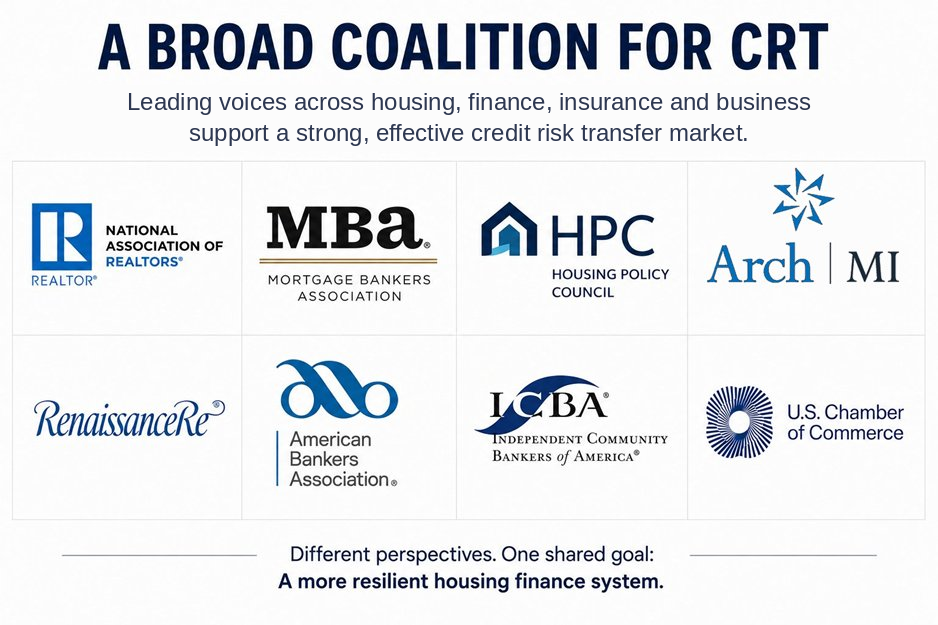
CRT is one of the rare housing finance topics where Republicans and Democrats nod in the same direction — and where the trade associations behind them line up as well.
On Capitol Hill: Last summer, Sen. Mike Rounds, R-South Dakota, and Rep. Mike Flood, R-Nebraska, chairs of the relevant Senate and House subcommittees, sent a bicameral letter to FHFA Director Pulte commending his commitment to CRT.
“Housing affordability and system stability are top priorities for Americans today,” they stated in the letter. “De-concentrating mortgage credit risk away from the government to willing private sector participants through CRT can promote both of those goals.”
On April 22, the House Subcommittee on Housing and Insurance held a hearing titled "Diversifying Risk: The Benefits of Reinsurance and Credit Risk Transfer."
What They’re Saying:
"Risk transfer tools... and reinsurance and Credit Risk Transfer all help answer that question on who picks up those losses by bringing private capital in before losses fall on the backs of taxpayers." — U.S. Rep. French Hill, R-Arkansas, Chairman, House Financial Services Committee.